
October 24, 197550 years ago
Iceland’s Women’s Day Off brings the country to a standstill
Key facts
- Location
Iceland
especially Reykjavík
- Outcome
Nationwide withdrawal of women’s paid and unpaid labor
mass demonstrations
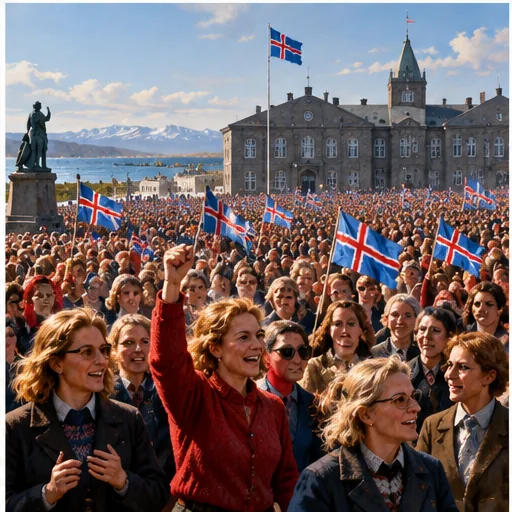
On 24 October 1975, an estimated 90 percent of Icelandic women stopped paid work and household duties to demonstrate their importance to society. Large public gatherings, particularly in Reykjavík, turned the Women’s Day Off into a landmark of the struggle for equality.
Why women called for action
In the 1970s, Icelandic women faced unequal wages and limited influence over many public decisions. Their contribution to homes, childcare, services and paid employment was often taken for granted. The United Nations designated 1975 as International Women’s Year, giving activists a wider context for debates about equality. Icelandic women’s organizations planned a nationwide protest to make the economic and social value of their work visible. The chosen date, 24 October, was also United Nations Day.
The day women stopped working
On 24 October, a very large share of women refused to perform either paid jobs or unpaid household work. Schools, offices, shops and other workplaces struggled as their usual routines were disrupted. Demonstrations and meetings took place around the country. In central Reykjavík, an estimated 25,000 people gathered at Lækjartorg square, an extraordinary crowd for a nation with a small population. The protest was deliberately visible and collective rather than a series of isolated workplace disputes.
A demonstration of invisible labor
The protest’s power lay in showing what happened when work routinely performed by women suddenly stopped. Organizers estimated participation at about 90 percent, a figure that should be understood as an estimate rather than a census of every participant. Men, institutions and employers had to confront the dependence of daily life on women’s labor. The day connected the fight over pay with broader questions of respect, representation and the value of unpaid care.
A long-lasting example
Women’s Day Off became one of Iceland’s best-known public protests and an enduring reference point in debates about equality. Later actions commemorated or renewed the demand for fair treatment, including strikes and demonstrations in subsequent decades. The event did not eliminate inequality in 1975, and its legacy should not be reduced to a single later political outcome. Its historical significance lies in the scale of participation and the powerful public demonstration that an entire society depends on the work of women.
Related events

Also on this day


Sources
Illustrations on this page are AI-generated, not archival images.