
October 24, 1648377 years ago
Peace of Westphalia is signed
Key facts
- Location
Münster and Osnabrück
Westphalia
- Outcome
Peace settlement ending the Thirty Years’ War in the empire
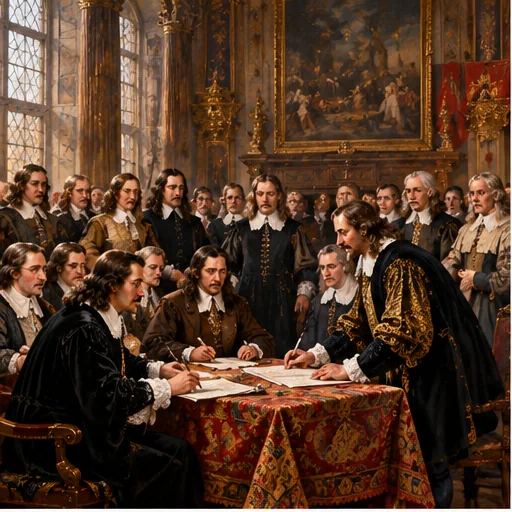
Treaties agreed at Münster and Osnabrück brought the Thirty Years’ War in the Holy Roman Empire to an end. The complex settlement addressed religious rights, territorial claims and relations among European powers, and became a landmark in diplomatic history.
Thirty years of war
The Thirty Years’ War began in 1618 amid religious and constitutional conflicts in the Holy Roman Empire. It grew into a much wider European war as outside powers intervened and armies moved across central Europe. Many regions suffered requisitions, destruction, displacement and disease. By the 1640s, exhaustion made a negotiated settlement increasingly urgent. Yet agreement required more than the end of fighting: governments had to confront religious rights, territorial possessions and the complex balance of imperial authority.
Two cities, many delegations
Peace negotiations were conducted in the Westphalian cities of Münster and Osnabrück. The choice reflected the difficulty of bringing Catholic and Protestant parties into a common process. Envoys represented the emperor, imperial territories, France, Sweden and other participants. Negotiations lasted years, with diplomats exchanging proposals about land, religion and security. The resulting agreements were not a single declaration by one ruler but a carefully negotiated collection of commitments among multiple governments.
What was agreed on 24 October
The treaties signed on 24 October 1648 helped end the Thirty Years’ War in the empire. The settlement adjusted territorial arrangements, confirmed rights for major Christian confessions and changed the relationship between the emperor and imperial estates. France and Sweden obtained important advantages, while the independence of the Dutch Republic and the Swiss Confederation was recognized within the wider peace settlement. Many practical questions remained to be implemented, demonstrating that peace was a process as well as a date.
A turning point in European diplomacy
Westphalia later became a shorthand for important ideas about political authority, territorial rule and negotiations between states. Historians caution, however, against claiming that modern state sovereignty was invented overnight in 1648. The settlement emerged from existing legal traditions and left the empire’s complex institutions in place. Its enduring significance lies in its scale, its intricate compromise and its example of using sustained diplomacy to resolve a continent-wide war.
Also on this day

Sources
Illustrations on this page are AI-generated, not archival images.