
October 24, 194679 years ago
First photograph of Earth from space
Key facts
- Location
White Sands Missile Range
New Mexico, United States
- Outcome
Earliest widely recognized photograph of Earth taken from space
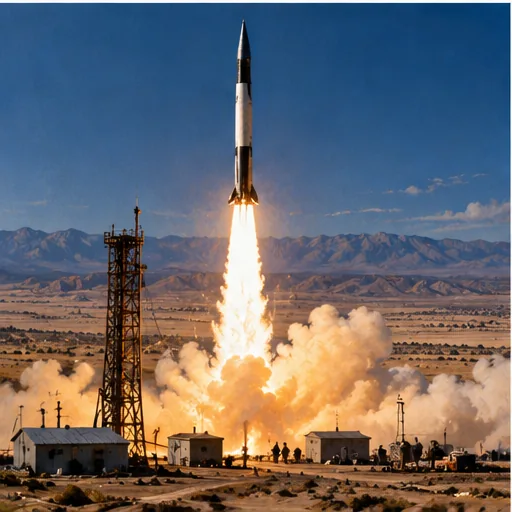
A camera aboard a V-2 rocket launched from White Sands, New Mexico, photographed Earth from roughly 105 kilometres above the surface. The rocket crashed, but the film survived, producing the earliest widely recognized pictures of our planet taken from space.
Before satellites
In 1946 there were no artificial Earth satellites. High-altitude photography relied on aircraft and experimental rockets. Scientists at the White Sands Missile Range in New Mexico were studying captured German V-2 rockets and the possibilities of carrying instruments into the upper atmosphere. Putting a camera into one of those rockets offered a perspective unavailable from aircraft. The experiment was part of early rocket research, years before spaceflight became a familiar subject of public imagination.
The flight of 24 October
On 24 October 1946 a V-2 rocket carried a 35-millimetre movie camera to an altitude of approximately 65 miles, or 105 kilometres. The camera captured frames at short intervals as the rocket climbed. After the flight the vehicle fell back to Earth and crashed at high speed. Despite the impact, its photographic film was recovered. The surviving frames revealed the curved horizon and broad atmospheric view of the planet from the edge of space.
What the images really showed
The 1946 photographs did not show the entire globe as a round disk. They were taken from a suborbital rocket, not from a satellite circling Earth. Their importance is precisely that they provided a view from space long before the first successful orbiting satellites. Later missions offered higher, clearer and eventually full-disk views of Earth. Distinguishing these milestones prevents one striking image from being confused with later achievements.
The beginning of a new perspective
Photographs of Earth from space later transformed science, navigation, weather forecasting and environmental awareness. The White Sands experiment was a modest technical success compared with modern spacecraft, yet it established that useful images could survive a rocket flight and return to researchers. It also introduced a visual perspective that would become culturally powerful: humans could look back at their own planet from beyond the atmosphere.
Also on this day


Sources
Illustrations on this page are AI-generated, not archival images.