
October 25, 196264 years ago
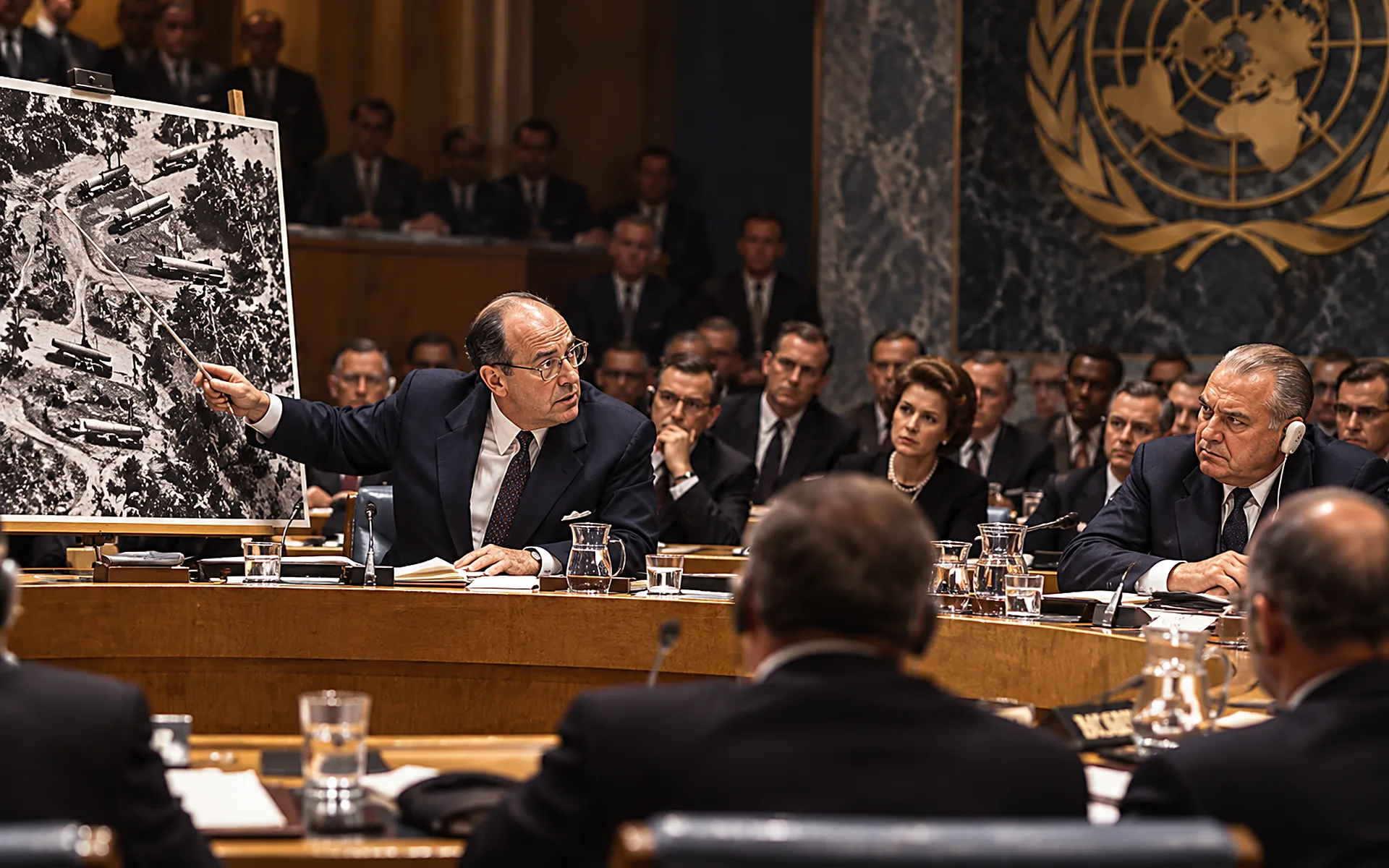
Adlai Stevenson confronts Valerian Zorin at the United Nations
Key facts
- Location
United Nations Security Council
New York
- Historical period
Cuban Missile Crisis
- Participants
Adlai Stevenson; Valerian Zorin; UN Security Council delegates
- Outcome
U.S. photographic evidence was presented publicly during the crisis
At the height of the Cuban Missile Crisis, U.S. ambassador Adlai Stevenson challenged Soviet ambassador Valerian Zorin in the Security Council and presented aerial photographs as evidence of Soviet missile sites in Cuba. The confrontation became a defining public moment of the crisis.
A nuclear crisis moves into the UN chamber
By 25 October 1962 the Cuban Missile Crisis had become both a military confrontation and a public contest over credibility. U.S. reconnaissance had identified Soviet nuclear-capable missile sites in Cuba, President John F. Kennedy had announced a naval quarantine, and Washington and Moscow were exchanging urgent messages. Some Soviet ships turned away from the quarantine line, but missile construction in Cuba continued. Diplomacy therefore moved through several channels at once, including talks involving UN Secretary-General U Thant. In New York, the Security Council became a stage on which each superpower tried to persuade international opinion that the other was responsible for the danger.
Stevenson presses Zorin for an answer
U.S. ambassador Adlai Stevenson used the Security Council debate to confront Soviet ambassador Valerian Zorin directly. Stevenson asked whether the Soviet Union had placed offensive missiles in Cuba and demanded a yes-or-no answer. Zorin refused to respond on Stevenson’s terms, saying he was not in an American courtroom. Stevenson answered that he was prepared to wait for the reply. The exchange was unusually sharp for a diplomatic chamber and immediately became one of the crisis’s most remembered scenes. It mattered not because the argument itself changed Soviet policy, but because the United States was about to make its intelligence case in public rather than asking the world simply to trust secret assessments.
Photographs become diplomatic evidence
Stevenson then introduced enlarged aerial photographs of Cuban missile sites, with intelligence specialists explaining the installations visible in the images. The presentation did not eliminate every dispute over interpretation, but it gave the U.S. argument a concrete visual form that television and newspapers could reproduce around the world. At the same time, private diplomacy continued: Kennedy and Khrushchev still had to find a formula that could remove the missiles without triggering war. The Security Council confrontation therefore shows two dimensions of crisis management operating together — public persuasion and confidential negotiation. The missiles were ultimately removed after an agreement announced days later, while the Stevenson-Zorin exchange remained the iconic public image of the diplomatic battle. The episode also showed how intelligence imagery, once declassified for diplomatic use, could become a weapon of public persuasion in an international emergency.
Also on this day
Sources
Illustrations on this page are AI-generated, not archival images.