
October 25, 1760266 years ago
George III becomes king of Great Britain
Key facts
- Location
Great Britain
accession proclaimed in London
- Historical period
Seven Years’ War era
- Participants
George III; Privy Council; British political establishment
- Outcome
George III succeeds George II and begins a reign lasting until 1820
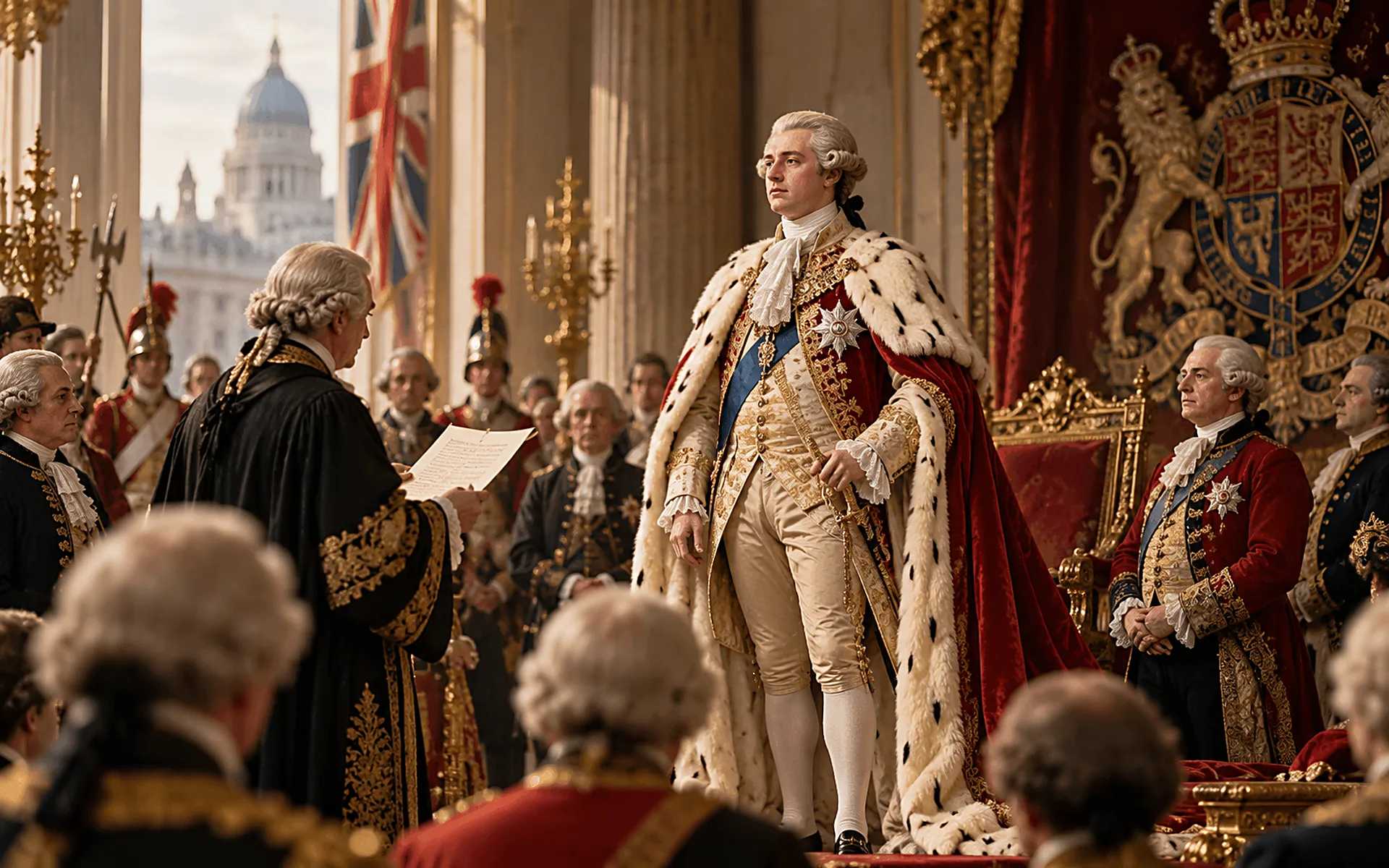
George III acceded to the British throne after the death of his grandfather George II. The 22-year-old monarch began a reign that would span nearly six decades and include the American Revolution, wars with France and major changes in British political life.
A young king inherits the crown
George III became king on 25 October 1760 when his grandfather George II died. He was twenty-two years old and had been Prince of Wales since the death of his father, Frederick, in 1751. The accession was immediate under hereditary monarchy; coronation came later, in September 1761. On the day of accession the Privy Council met, George took the required oaths, and proclamations announced the new sovereign. His arrival on the throne was notable because he was the first Hanoverian monarch born in Britain and to use English as his first language. He would later emphasize that identity in public statements, seeking to present himself as a British rather than a distant German ruler.
A reign shaped by empire and war
George inherited a kingdom already fighting the Seven Years’ War. Britain emerged from that conflict with major imperial gains, but the costs of empire helped produce new disputes over taxation and government in the North American colonies. Those disputes became the American Revolution, and the loss of the thirteen colonies became the most famous political crisis of George’s reign. Yet his long rule also covered the French Revolutionary and Napoleonic wars, expansion in India, the union with Ireland in 1801, and major changes in party politics. The king was not an absolute ruler: policy depended on ministers and Parliament, but his preferences, appointments and political relationships mattered greatly in the eighteenth-century constitutional system.
The monarch behind a changing constitution
George III’s health deteriorated in later life, and from 1811 his son governed as Prince Regent. The king died in 1820 after nearly sixty years on the throne. His reputation has changed repeatedly: for generations he was remembered in the United States as the king against whom independence was declared, while British histories debated how much responsibility he bore for ministerial policy. Modern accounts place him in a more complex constitutional setting and also emphasize his interests in agriculture, science, collecting and the arts. The accession of 25 October 1760 therefore opened not simply a personal reign but an era in which monarchy, Parliament and an expanding global empire were forced to adapt to profound political change. His long reign also made the crown itself adapt to a public world increasingly shaped by newspapers, parliamentary debate and imperial conflict.
Also on this day



Sources
Illustrations on this page are AI-generated, not archival images.