
October 25, 1415611 years ago
Henry V wins the Battle of Agincourt
Key facts
- Location
Near Azincourt
northern France
- Historical period
Hundred Years’ War
- Participants
English army under Henry V; French army led by senior nobles and the constable Charles d’Albret
- Outcome
Decisive English victory
heavy losses among the French nobility
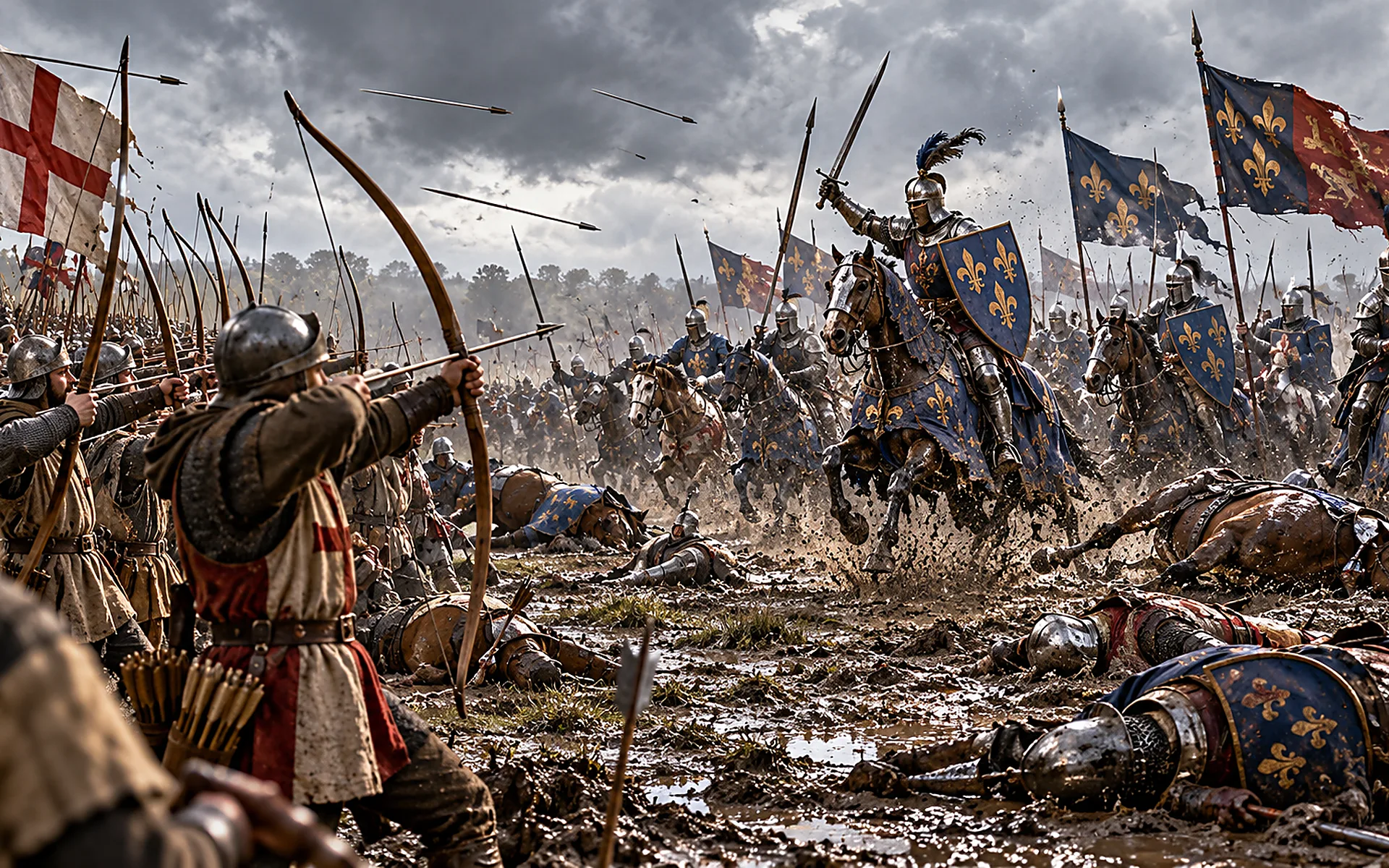
Henry V’s exhausted English army defeated a larger French force near Azincourt in northern France. Mud, a narrow battlefield and massed longbowmen helped turn 25 October 1415 into one of the best-known battles of the Hundred Years’ War.
A campaign running out of strength
After taking Harfleur in September 1415, Henry V did not simply sail home. He led a reduced English army toward Calais, hoping to demonstrate that his claim to territory in France had real military force behind it. Disease, hunger and weeks of marching had weakened the army. French forces shadowed the march, blocked crossings of the Somme and gathered in growing numbers. By 24 October the English found their road north obstructed near Azincourt. Modern scholarship debates the exact size of both armies, but the English were clearly tired, short of supplies and outnumbered. Henry therefore entered the battle of 25 October from a position that looked strategically dangerous rather than triumphant.
Mud, narrow ground and longbows
The ground shaped the fight. The armies faced each other across recently ploughed land hemmed in by woods. Rain had left the soil wet and increasingly difficult for heavily equipped men and horses. Henry’s archers formed a large part of the English force and protected their positions with sharpened stakes. When the English advanced enough to bring the French within longbow range, French cavalry and men-at-arms were drawn into a confined approach. Arrows disrupted the mounted attacks, while the dense formation of French troops compressed as it moved through the mud. The battlefield did not make victory automatic, but it reduced the advantage of superior French numbers and rewarded the English combination of archers and dismounted men-at-arms.
The collapse of the French attack
French mounted attacks failed to break the English archers. The main body of French men-at-arms then advanced on foot, struggling across the churned ground under continued arrow fire. When they reached the English line, the fighting became a close and crowded melee. Men in the following ranks pressed into those ahead, and fallen soldiers created additional obstacles. English archers, once their arrows were spent or the fighting closed, joined the combat with hand weapons. The result was a devastating French defeat in which many nobles were killed or captured. Casualty estimates vary widely in the sources, so modern historians treat precise totals cautiously. What is not in doubt is that Henry retained the field and was able to continue toward Calais.
Victory, politics and memory
Agincourt did not end the Hundred Years’ War, but it transformed Henry V’s reputation and strengthened his position in France. Further campaigns followed, and in 1420 the Treaty of Troyes recognized Henry as heir to Charles VI of France, although Henry died before he could inherit the crown. The battle also acquired a cultural life far beyond its immediate military consequences. English chronicles celebrated it, and Shakespeare’s Henry V later made Saint Crispin’s Day central to a national story of courage against the odds. Modern historians have revised many older assumptions about army size, casualties and tactics, but the battle remains a striking example of how terrain, organization, fatigue and battlefield choices can overturn apparently favorable numerical odds.
Also on this day



Sources
Illustrations on this page are AI-generated, not archival images.