
October 21, 198343 years ago
The metre is defined using the speed of light
Key facts
- Participants
17th General Conference on Weights and Measures (CGPM)
- Outcome
Metre defined through light travel in vacuum
exact light speed 299,792,458 m/s
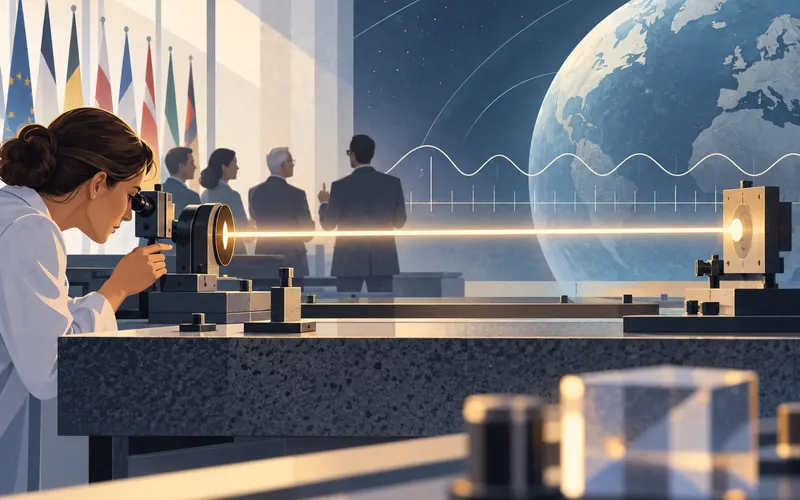
The international measurement conference adopted a definition of the metre based on how far light travels in vacuum in 1/299,792,458 of a second.
From a metal bar to the atom
Reliable measurement depends on units that laboratories can reproduce. In 1889, the international metre was represented by a carefully maintained platinum-iridium bar. In 1960, the definition changed to a wavelength of light emitted by krypton-86 atoms. That improved precision but still imposed limits as optical measurement became more demanding.
As lasers and frequency measurements improved, scientists could compare light more precisely than the older standard allowed. The growing question was whether the metre should depend on a particular object or emission line, or instead on a fundamental constant of nature: the speed of light in vacuum.
The decision of October 1983
The 17th General Conference on Weights and Measures met from 17 to 21 October 1983. It adopted a new definition: one metre was the distance light travels in vacuum during 1/299,792,458 of a second. This made the speed of light exactly 299,792,458 metres per second within the system of units.
The decision did not mean that ordinary rulers or measuring tapes suddenly changed length. The new definition was designed to preserve continuity with earlier measurements while giving laboratories a more reproducible reference. Instead of relying on a single physical object, the unit could be realized through time, light and carefully specified instruments.
Why the change mattered
A stable metre is essential in engineering, manufacturing, astronomy and geodesy. The light-based definition made high-precision length measurements easier to compare internationally. It also illustrates a wider scientific shift: defining units through constants of nature rather than artifacts that can age, change or be damaged.
In 2018, the wording of the metre’s definition was updated as part of a broader revision of the International System of Units that took effect in 2019. The exact value of the speed of light remained unchanged. The 1983 decision was therefore a lasting step toward the modern system used by laboratories today.
What the definition means in practice
In practice, laboratories do not need to watch a beam travel exactly one metre and stop a clock. They can use stabilized lasers, optical interferometry and known frequencies to realize the metre with exceptionally small uncertainties. The 1983 definition tied the unit of length to the already defined second, making measurements of distance and time part of one coherent scientific system.
Also on this day


Sources
Illustrations on this page are AI-generated, not archival images.