
October 20, 1803223 years ago
U.S. Senate ratifies the Louisiana Purchase
Key facts
- Location
Washington
D.C., United States
- Participants
United States Senate; Jefferson administration; French Republic
- Outcome
Treaty approved for ratification, 24 votes to 7
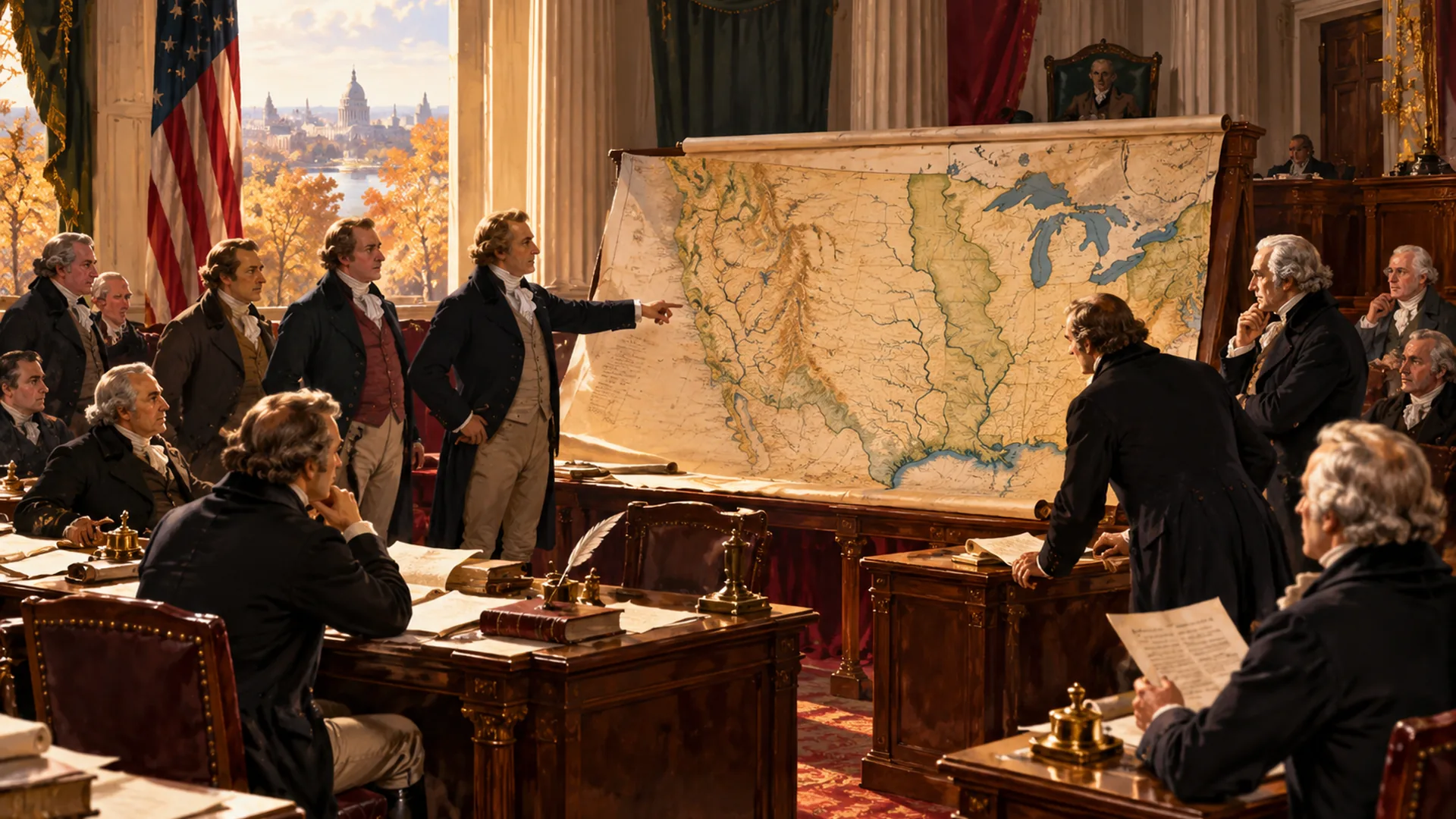
The United States Senate approved the Louisiana Purchase, confirming a deal that doubled the size of the young republic.
A continental opportunity
The Louisiana Purchase emerged from a diplomatic problem: American farmers and merchants depended on the Mississippi River and the port of New Orleans to transport goods. France had regained control of Louisiana from Spain, alarming President Thomas Jefferson. His envoys Robert Livingston and James Monroe sought access to New Orleans, but French authorities offered to sell a vast territory. Napoleon needed money and was turning away from his ambitions for a North American empire.
The treaty and the Senate vote
The treaty was signed in Paris on 30 April 1803 for fifteen million dollars. The proposed acquisition raised constitutional questions in the United States: the Constitution did not explicitly explain how the federal government could acquire such territory. Nevertheless, the administration submitted the agreement for ratification. On 20 October 1803, the Senate voted 24 to 7 to approve the treaty. The vote was not the date the treaty was first signed, nor the formal transfer ceremony in New Orleans later that year.
What changed on the map
The Louisiana Territory stretched west of the Mississippi across a huge part of continental North America. Its boundaries were not fully surveyed, and sovereignty on paper differed greatly from actual control on the ground. Many Indigenous nations already lived on these lands and maintained political systems, diplomatic relations and territorial claims of their own. The transaction between France and the United States did not constitute consent by those nations. For the American republic, however, the agreement created room for expansion and new contests over land and political power.
A decision with lasting consequences
The purchase roughly doubled the area claimed by the United States, strengthening its position in the Mississippi basin. Explorations, surveys, settlement and political disputes followed. The transformation helped shape later states but also accelerated pressures on Indigenous communities and intensified debates about slavery in expanding territories. The Senate vote of 20 October was therefore more than an administrative formality: it confirmed one of the most consequential territorial agreements in United States history, while leaving unresolved questions about who had the right to determine the future of the land.
A new question for the republic
Jefferson himself had worried about the constitutional basis for acquiring territory, and members of Congress debated the practical consequences of the purchase. Americans did not yet possess detailed knowledge of much of the land; mapping expeditions, including the Lewis and Clark journey begun in 1804, would soon attempt to describe routes, resources and peoples. The purchase also transformed diplomacy with European powers, for Spain and Britain remained active in North America. These uncertainties explain why the October Senate vote was an important starting point for policy rather than the end of all questions raised by the transaction.
Also on this day


Sources
Illustrations on this page are AI-generated, not archival images.