
October 21, 196066 years ago
Kennedy and Nixon hold their final televised debate
Key facts
- Location
ABC studios
New York City, United States
- Participants
John F. Kennedy (Democratic senator); Richard M. Nixon (Republican vice president); moderator Quincy Howe
- Outcome
Fourth and final televised debate of the 1960 presidential campaign
focused on foreign policy
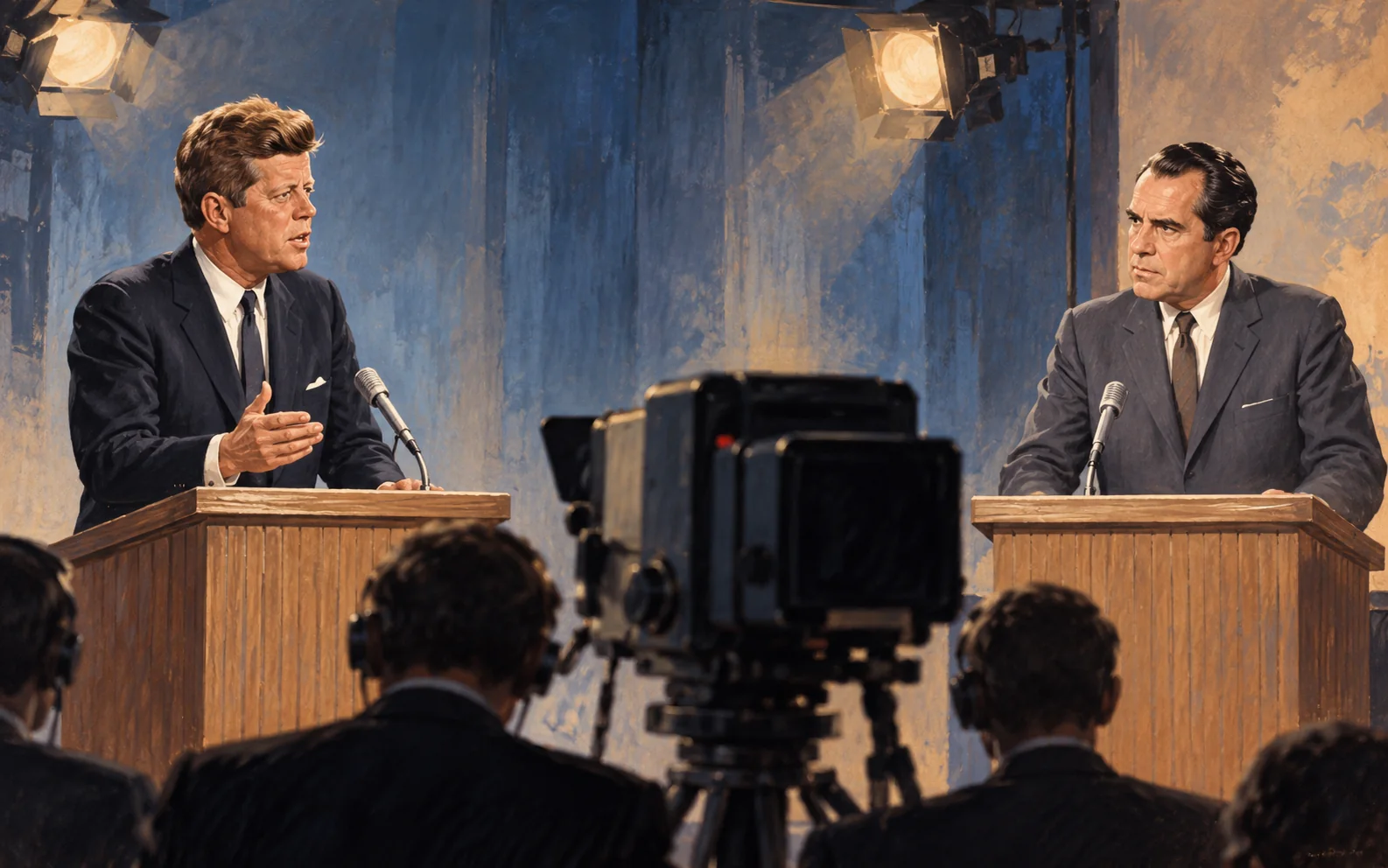
Senator John F. Kennedy and Vice President Richard Nixon met in New York for their fourth and final televised presidential debate, focusing on foreign policy and the Cold War.
How television changed the 1960 campaign
The 1960 presidential election brought a new kind of national encounter: the leading candidates could be seen and heard debating on television in millions of homes. Democratic senator John F. Kennedy and Republican vice president Richard Nixon agreed to four joint broadcasts. Their opening debate, on 26 September, addressed domestic questions and attracted an exceptionally large audience.
Subsequent debates explored other subjects and even experimented with broadcasting candidates from studios on opposite coasts. Television did not replace speeches, newspapers or radio, but it made candidates’ presentation and their responses under questioning part of a shared public experience.
The final encounter on 21 October
On Friday, 21 October 1960, Kennedy and Nixon appeared together at ABC’s studios in New York City for the fourth and final debate. The one-hour broadcast began at 10 p.m. Eastern time. ABC journalist Quincy Howe moderated a panel that also included reporters from other networks.
Unlike the first debate, which centred on domestic policy, the final discussion was devoted entirely to foreign affairs. Both candidates delivered opening statements, answered questions from journalists, responded to each other, and made closing remarks under a fixed timetable.
Cuba, the Cold War and global influence
Relations with Cuba were a central subject. The Cuban Revolution had brought Fidel Castro to power the previous year, and American leaders were debating how the United States should respond. Kennedy and Nixon discussed the challenge of communist influence, national security and the position of the United States in the wider world.
The debate also ranged across relations with the Soviet Union, international development, alliances and the reputation of American leadership. Kennedy criticised aspects of the administration’s foreign-policy record, while Nixon defended its experience and accomplishments. These were campaign arguments; the programme did not establish an official verdict on which position was correct.
Why the debates mattered
The meeting completed the four televised Kennedy–Nixon debates, an experiment watched by tens of millions of Americans. The Commission on Presidential Debates reports an audience of 60.4 million for the final broadcast. Viewers could assess both the candidates’ words and how they handled a live exchange on major international questions.
Kennedy went on to win the presidential election held in November 1960. Historians continue to examine how much television itself affected voters, but the debates helped establish the televised candidate encounter as a possible part of modern election campaigning. Recordings and complete transcripts make it possible to study what the candidates actually said.
Also on this day
Sources
Illustrations on this page are AI-generated, not archival images.