
October 21, 195967 years ago
Guggenheim Museum opens in New York
Key facts
- Location
Fifth Avenue
Manhattan, New York City, United States
- Participants
Architect Frank Lloyd Wright; museum founded from Solomon R. Guggenheim’s collection
- Outcome
Opening of the permanent spiral museum building
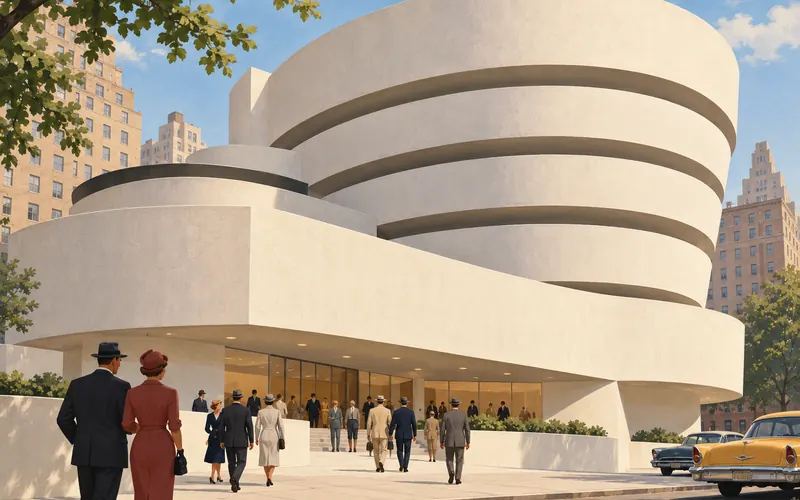
The Solomon R. Guggenheim Museum opened its landmark spiral building, designed by Frank Lloyd Wright, to the public in New York City.
A new home for modern art
The Solomon R. Guggenheim Foundation was established in 1937 to support a growing collection of modern art. Two years later its Museum of Non-Objective Painting opened in New York. Artist and adviser Hilla Rebay believed the collection deserved a permanent building that would be as unconventional as the artworks inside.
In 1943, Rebay approached architect Frank Lloyd Wright. Instead of conventional rectangular galleries, Wright developed a museum organized around a sweeping spiral ramp and central rotunda. Planning and construction took years, with arguments about how visitors should move through the building and how paintings should be displayed.
The opening on 21 October 1959
The new Solomon R. Guggenheim Museum opened on 21 October 1959 on Fifth Avenue in Manhattan. The curving white building stood apart from its rectangular neighbors. Visitors encountered artworks along a continuous interior ramp, making the museum itself part of the experience rather than merely a neutral backdrop.
Wright had died earlier that year and never saw the completed museum in use. The inaugural exhibition presented works from the museum’s collection, but practical questions immediately emerged. Museum director James Johnson Sweeney and the architect had disagreed over lighting, wall angles and the proper way to hang paintings.
A museum that challenged expectations
Wright treated the museum as an integrated work of architecture. Its spiral gallery encouraged a continuous route rather than a sequence of separate rooms. Yet the same design could make exhibition planning difficult: curved walls, the sloping floor and strong architectural identity competed with the needs of individual artworks.
Those tensions are part of the building’s significance. The Guggenheim did not simply provide storage space for art: it asked whether a museum could shape how viewers experienced a collection. Its opening therefore belongs to both the history of modern art and the history of twentieth-century architecture.
A lasting architectural landmark
Over time, the Guggenheim became one of New York’s most recognizable buildings. Its fame spread far beyond the exhibitions held inside: photographs of the spiral façade made it an international symbol of modern architecture. The building was later included in a UNESCO World Heritage listing of Frank Lloyd Wright works. The debate between architecture and art remains central to its appeal.
Also on this day



Sources
Illustrations on this page are AI-generated, not archival images.