
Historical period
Napoleonic Wars
1803–1815
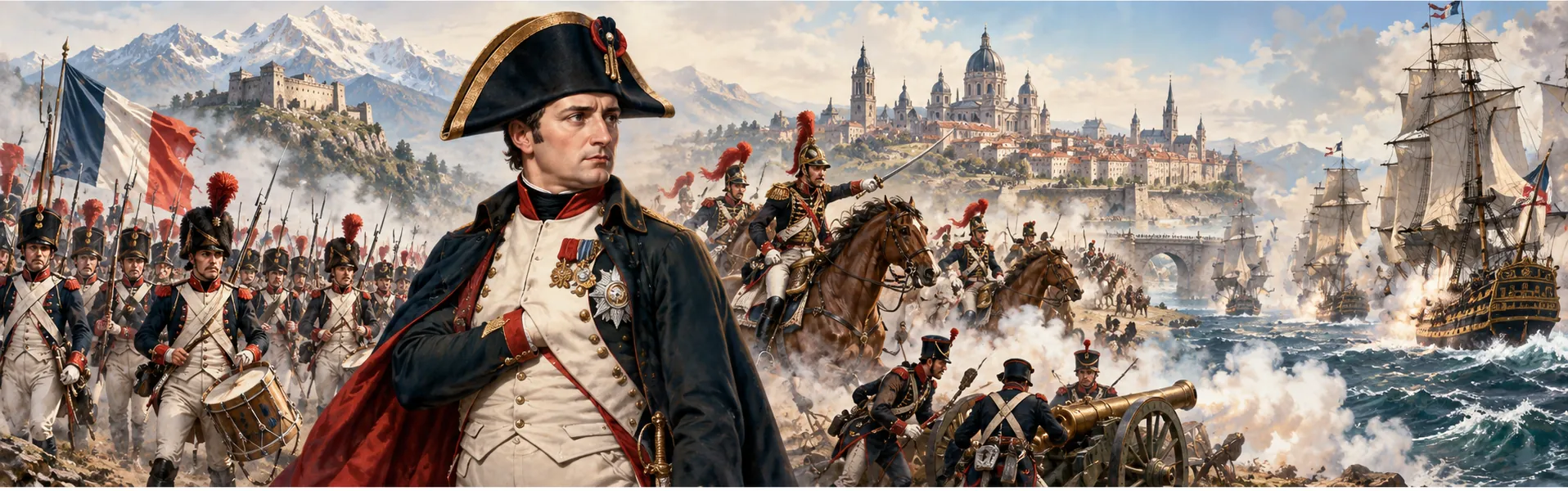
The Napoleonic Wars (1803–1815) were a series of conflicts between France under Napoleon Bonaparte and changing coalitions of European powers. They stretched from the Atlantic to Russia, involved warfare on land and at sea, and repeatedly redrew the political map of Europe. French victories brought Napoleon extraordinary influence, but resistance in Spain, the disastrous Russian campaign and renewed allied offensives eventually brought his empire down. His final defeat came at Waterloo in June 1815.
Origins and background
The wars grew out of the upheaval that followed the French Revolution. The French Revolutionary Wars had spread fighting across much of Europe, and the Peace of Amiens in 1802 provided only a brief respite. Britain and France resumed hostilities in May 1803 amid unresolved disputes about power, security and French expansion. Napoleon, then First Consul, became Emperor of the French in 1804.
The conflict was not one uninterrupted war between two fixed sides. Governments repeatedly made peace, formed new alliances or changed their position as Napoleon’s armies advanced. France dominated large areas of mainland Europe at different moments, while Britain remained its most persistent opponent and relied on naval power as well as continental partners.
Napoleon combined rapid military manoeuvre with political reorganisation. Victories could lead to territorial changes, new client kingdoms and alliances that tied other states to France. These arrangements often brought administrative change, but they also provoked resistance and created fresh enemies.
The opposing powers
Napoleon led the French state and its main field armies. His Grande Armée relied on formations able to march and fight with considerable independence, supported by artillery, cavalry and extensive recruitment. France also drew soldiers and resources from allied and dependent states, including territories in Italy and the German lands.
Against France stood changing coalitions that at various times included Britain, Austria, Russia, Prussia, Portugal, Spain and Sweden. Their aims were not identical: some feared French territorial expansion, others defended their sovereignty, trade or position in Europe. Alliances shifted sharply; Spain, for example, fought alongside France at Trafalgar in 1805 but became a major theatre of resistance to French occupation from 1808.
Commanders became prominent figures in the conflict. Horatio Nelson led the British fleet at Trafalgar; Arthur Wellesley, later Duke of Wellington, directed major campaigns in the Iberian Peninsula and commanded allied forces at Waterloo. The Prussian field marshal Gebhard Leberecht von Blücher played a decisive role in the final battle of 1815. Yet the wars were fought and endured by vast numbers of ordinary soldiers and civilians, not only famous leaders.
Major campaigns and turning points
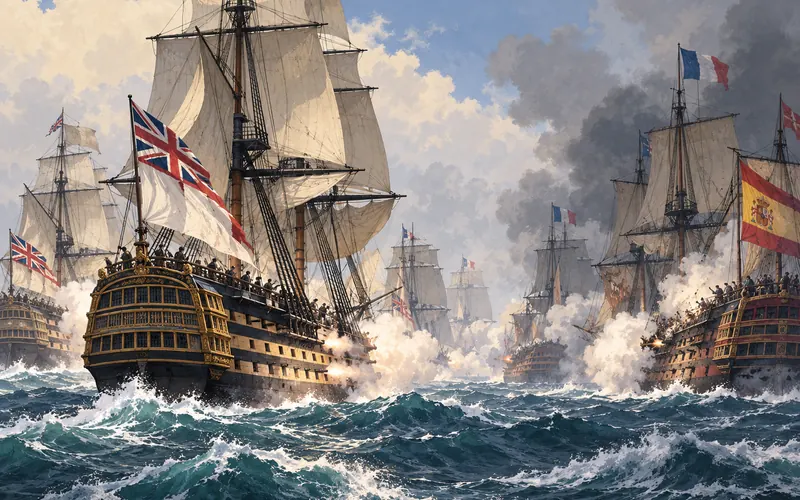
In 1805, Napoleon defeated Austrian and Russian forces at Austerlitz on 2 December, one of his most celebrated victories on land. Six weeks earlier, on 21 October, Britain had defeated the combined French and Spanish fleets at Trafalgar. These outcomes showed the contrasting balance of strength: Napoleon’s armies dominated major continental battlefields, while the Royal Navy maintained Britain’s position at sea.
Prussia was defeated at Jena and Auerstedt in October 1806, and further French victories led to the Treaties of Tilsit in 1807. At the height of his power, Napoleon sought to weaken Britain economically through the Continental System, which restricted trade with the British Isles. Enforcement was difficult and tensions over trade and sovereignty helped extend the conflict.
In 1808, resistance to French rule spread through Spain, opening the Peninsular War. Spanish and Portuguese forces, including guerrilla fighters, operated alongside British troops. The struggle tied down French resources for years. Meanwhile, Austria renewed war against Napoleon in 1809, but French victory at Wagram again forced a settlement on French terms.
Napoleon invaded Russia in 1812 with a vast multinational army. After the costly battle of Borodino, his troops entered Moscow, but the retreat that followed destroyed much of the invading force through combat, exhaustion, shortages and severe weather. In 1813, a new coalition defeated Napoleon at Leipzig. Allied armies entered France in 1814, forcing him to abdicate and go into exile on Elba.
Napoleon returned from Elba in 1815 for the Hundred Days. On 18 June, his army was defeated at Waterloo by the forces commanded by Wellington and Blücher. Napoleon abdicated again and was sent into exile on the distant island of Saint Helena. The defeat ended his rule and brought the Napoleonic Wars to a close.
Consequences and historical legacy
The wars transformed European politics. The Holy Roman Empire came to an end in 1806, and borders and ruling dynasties shifted repeatedly. After Napoleon’s fall, diplomats at the Congress of Vienna (1814–1815) sought to establish a durable balance of power. Their settlement reshaped Europe and helped create the German Confederation.
Napoleonic rule also left an institutional legacy. In territories under French influence, legal and administrative reforms challenged older privileges and spread new models of government. Their impact differed from place to place: some reforms survived, while military occupation, taxation and conscription provoked strong opposition.
The human cost was immense. Battles, disease, shortages and displacement affected soldiers and civilians across the continent. The period is remembered for extraordinary commanders and dramatic victories, but its wider history is also one of communities disrupted by years of war. Its political settlements and controversies continued to influence Europe long after 1815.
Historical timeline
Sources
- Royal Collection Trust — Napoleonic Wars (1803–15)
- National Army Museum — Napoleonic Wars
- National Museum of the Royal Navy — Battle of Trafalgar
- National Army Museum — Peninsular War
- National Army Museum — The Emperor’s Samovars (1812 campaign)
- National Army Museum — Battle of Waterloo
- Austrian UNESCO Commission — Final Act of the Congress of Vienna
- Fondation Napoléon — Jena and Auerstedt, 1806
Illustrations on this page are AI-generated, not archival images.