
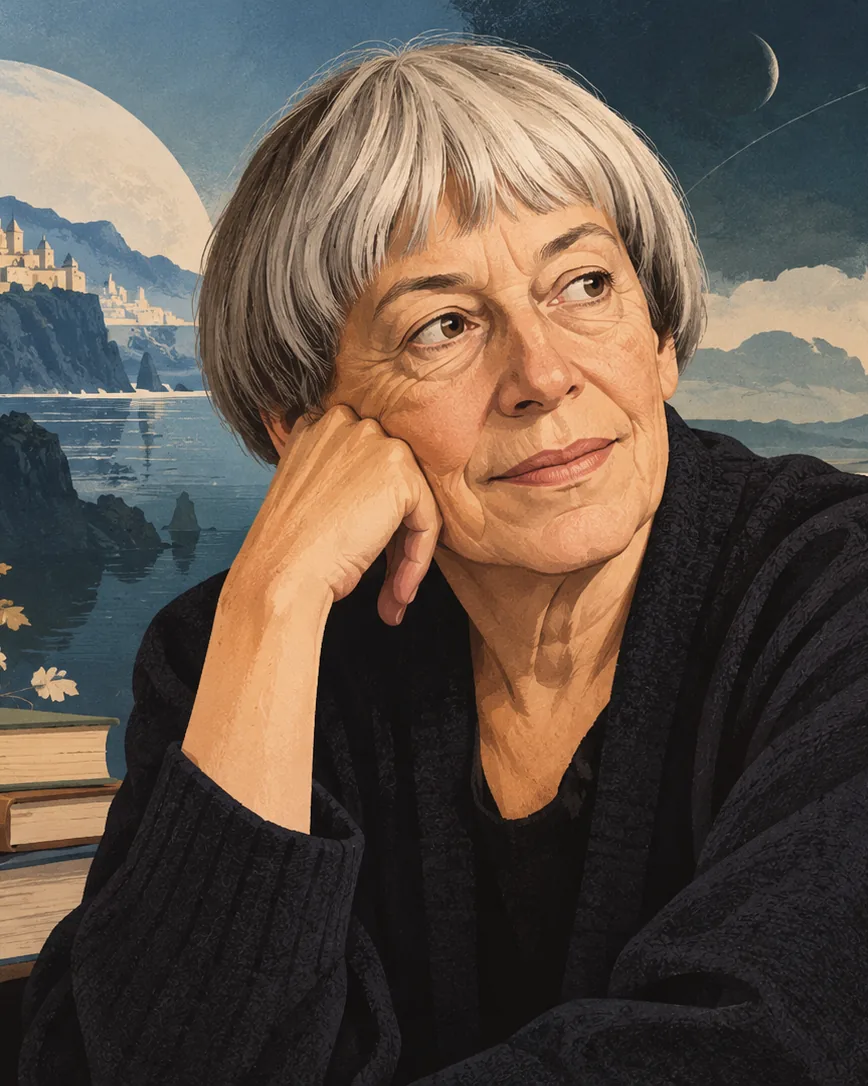
Ursula K. Le Guin (1929–2018) was an American novelist, poet and essayist whose science fiction and fantasy examined power, culture, gender and freedom. Her Earthsea books, The Left Hand of Darkness and The Dispossessed helped establish speculative fiction as a field for serious literary and philosophical questions.
- Born
- October 21, 1929 · Berkeley, California, United States
- Died
- January 22, 2018 · Portland, Oregon, United States
- Nationality
- American
- Historical role
- Novelist, science-fiction and fantasy writer, poet and essayist
Growing up among books and ideas
Le Guin was born Ursula Kroeber on 21 October 1929 in Berkeley, California. Her father, Alfred Kroeber, was an anthropologist, and her mother, Theodora Kroeber, was a writer. Books, conversations about other cultures and stories from different traditions were important parts of her childhood.
She studied at Radcliffe College and then at Columbia University, focusing on literature and languages. In 1953 she married the historian Charles Le Guin, whom she had met in France. The couple later settled in Portland, Oregon, where she wrote much of the work for which she became famous.
The world of Earthsea
Her fantasy novel A Wizard of Earthsea appeared in 1968 and began a cycle of stories set among islands where names, language and magic are closely connected. The young wizard Ged learns that the pursuit of power carries costs and that maturity requires an understanding of oneself.
The Earthsea books offered an alternative to simple battles between good and evil. Le Guin explored responsibility, balance, death and the limits of control. As the series grew, she revisited its assumptions about who possesses power and whose experience deserves to be told.
Poetry, essays and other forms
Le Guin wrote far beyond novels: poetry, short stories, children’s books, literary criticism, essays and translations. She returned repeatedly to questions of language, imagination and ethical responsibility. These works demonstrate that her interest was not confined to inventing other planets or magical worlds.
She also spoke publicly about the value of literature and the economic pressures facing writers. For Le Guin, imaginative fiction was a way of examining reality, not escaping it. Her influence extended to authors, readers and scholars working well beyond the science-fiction and fantasy genres.
Honors and continuing influence
Le Guin received multiple Hugo and Nebula Awards and the National Book Foundation’s Medal for Distinguished Contribution to American Letters in 2014. Her works remain widely read and studied because they combine memorable storytelling with searching questions about power, ecology, identity and cooperation.
She died at her home in Portland on 22 January 2018. Her work continues to invite readers to imagine that the world could be organized differently, while taking seriously the difficulty of change. That blend of imaginative freedom and moral complexity remains central to her literary legacy.
Sources
Illustrations on this page are AI-generated, not archival images.