
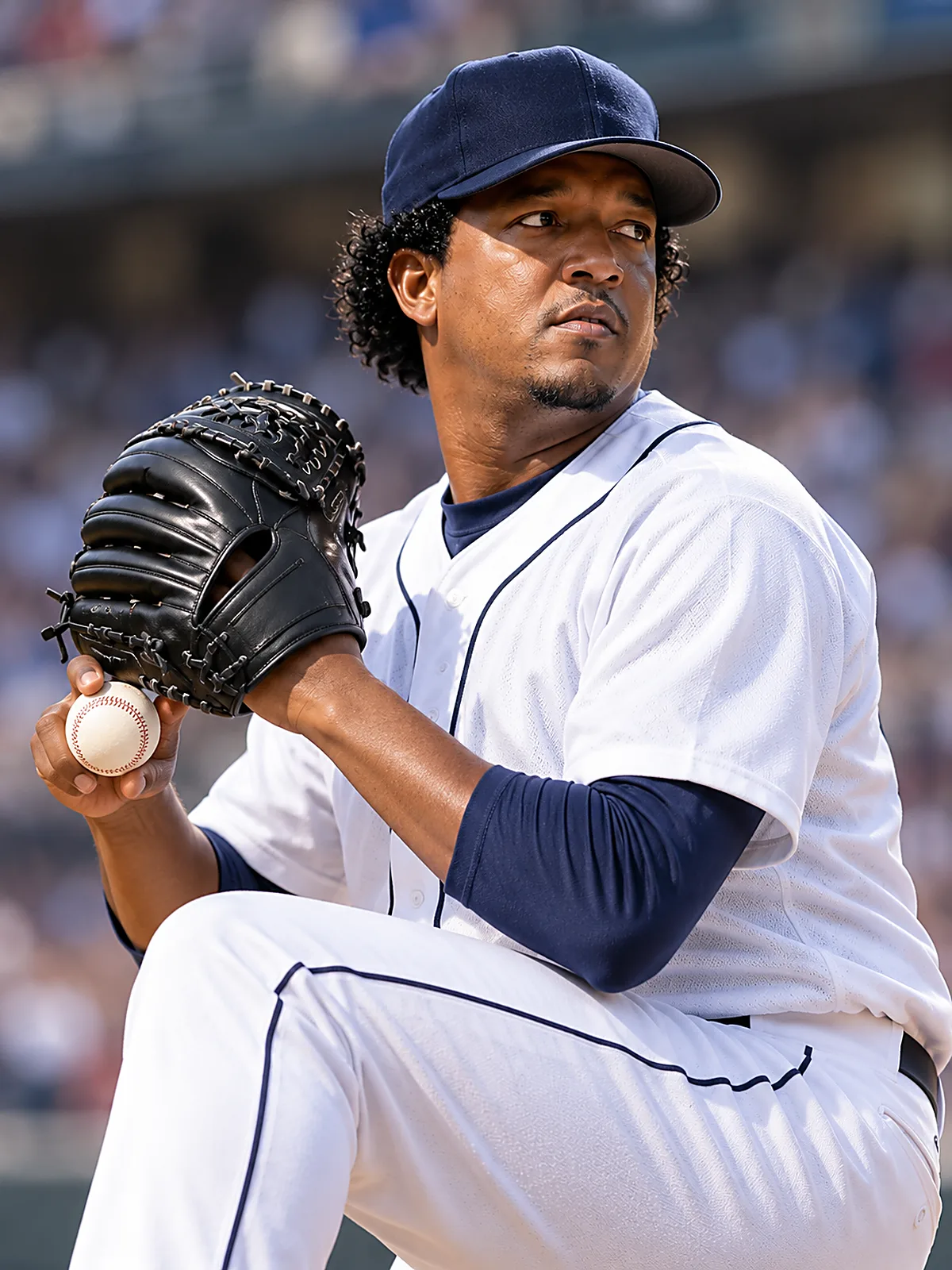
Pedro Martínez combined explosive velocity, one of baseball’s great changeups and exceptional command. At his peak he dominated hitters during an era of unusually high offense, won three Cy Young Awards and later became a first-ballot member of the Baseball Hall of Fame.
- Born
- October 25, 1971 · Manoguayabo, Dominican Republic
- Nationality
- Dominican
- Historical role
- Baseball pitcher · Baseball analyst
From Manoguayabo to professional baseball
Pedro Jaime Martínez was born on 25 October 1971 in Manoguayabo, near Santo Domingo, one of six children in a family of modest means. Baseball was central to the neighborhood and to the Martínez family. His older brother Ramón became a professional pitcher and helped draw scouts’ attention to Pedro. The Los Angeles Dodgers signed Pedro as an amateur free agent in 1988. He was slight for a power pitcher and some evaluators doubted that his body could handle a major-league starter’s workload. After developing in the minor leagues, he reached the majors with Los Angeles in 1992 and worked mainly as a reliever in 1993 before being traded to the Montreal Expos.
Montreal turns a talent into an ace
The trade to Montreal gave Martínez the opportunity to become a full-time starter. His combination of a rising fastball, sharp breaking pitches and a deceptive changeup grew increasingly effective. In 1995 he retired the first twenty-seven San Diego Padres batters he faced in a game that remained scoreless after nine innings; the perfect game ended only when he allowed a hit in the tenth. His breakthrough season came in 1997. Martínez went 17–8 with a 1.90 earned-run average, struck out 305 batters and won the National League Cy Young Award. He became the first Dominican pitcher to win the award. With Montreal unable to keep him long term, he was traded to the Boston Red Sox after the season.
Dominance in Boston
In Boston, Martínez produced one of the most extraordinary pitching peaks in modern baseball. In 1999 he went 23–4, led the American League with a 2.07 ERA and 313 strikeouts, and won the pitching Triple Crown and Cy Young Award. The following season may have been even more impressive: his 1.74 ERA and 0.737 WHIP came during a period when league offense was extremely high. Hitters had to defend against upper-90s velocity while also respecting a changeup delivered with nearly identical arm speed. Martínez won a third Cy Young Award in 2000. Injuries interrupted later seasons, but he remained an elite starter and helped the Red Sox win the 2004 World Series, ending the franchise’s championship drought that dated to 1918.
Hall of Fame legacy
Martínez later pitched for the New York Mets and Philadelphia Phillies before ending his major-league career after 2009. He finished with 219 wins, a 2.93 career ERA and 3,154 strikeouts, numbers made more impressive by the offensive conditions of his era. In 2015 he was elected to the National Baseball Hall of Fame in his first year of eligibility, receiving more than ninety percent of the vote, and Boston retired his number 45. Martínez also became an important public figure for Dominican baseball and has supported educational and charitable work in his home country. As a television analyst he remains visible to new generations of fans. His career demonstrated that size did not determine power pitching and that deception, control and competitive intelligence could be as important as raw velocity.
Sources
Illustrations on this page are AI-generated, not archival images.