
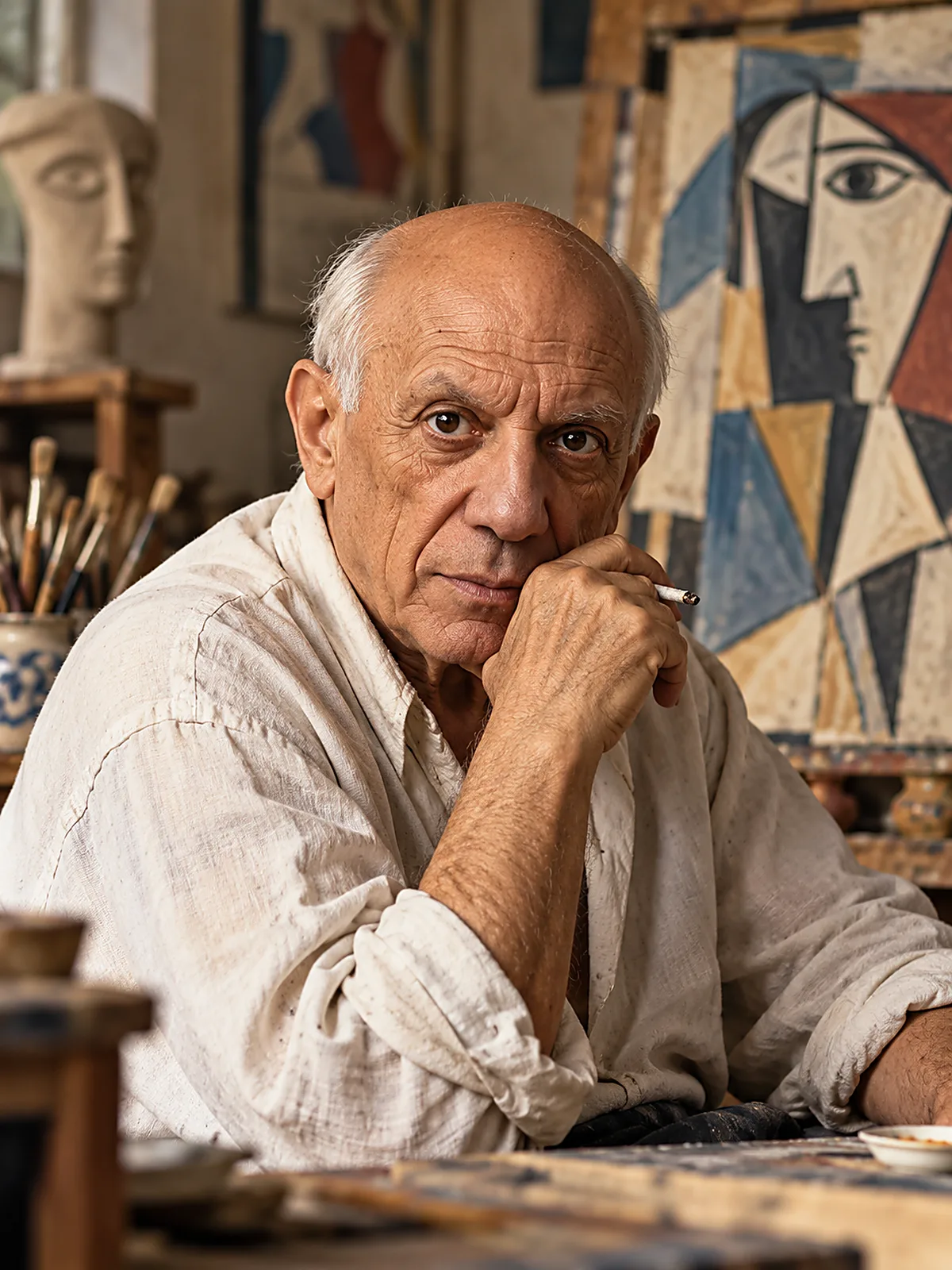
Pablo Picasso was one of the defining artists of the twentieth century. Across painting, sculpture, printmaking, ceramics and collage, he repeatedly reinvented his visual language and helped make Cubism a turning point in modern art.
- Born
- October 25, 1881 · Málaga, Spain
- Died
- April 8, 1973 · Mougins, France
- Nationality
- Spanish
- Historical role
- Painter · Sculptor · Printmaker
From Málaga to Barcelona and Paris
Pablo Ruiz Picasso was born in Málaga on 25 October 1881. His father, José Ruiz Blasco, was a painter and drawing teacher, and encouraged the boy’s extraordinary early ability. The family later moved to La Coruña and then Barcelona, where Picasso entered the art school La Lonja. He also briefly studied at the Royal Academy of San Fernando in Madrid but preferred to learn from museums, studios and the urban culture around him. At the end of the 1890s he joined the circle around Barcelona’s Els Quatre Gats café. He first visited Paris in 1900 and increasingly divided his life between Spain and France before settling in Paris in 1904.
Blue, Rose and a radical break
Picasso’s early Paris years produced the Blue Period, dominated by cool colors and images of poverty, isolation and grief. Around 1904–05 the palette lightened in the Rose Period, with circus performers and warmer tones. He was already moving rapidly between styles rather than treating one visual solution as permanent. In 1907 Les Demoiselles d’Avignon marked a radical break with conventional space and the idealized human figure. Working closely with Georges Braque, Picasso then developed Cubism, fragmenting objects into shifting planes and multiple viewpoints. Analytical Cubism pushed this process toward near abstraction; Synthetic Cubism reintroduced stronger color, signs and pasted materials, helping to establish collage as a major modern technique.
Politics, Guernica and expanding media
Picasso never remained only a painter. He made sculpture, prints, stage designs and ceramics, shifting freely between media. Political events also entered his work with particular force in the 1930s. After the bombing of the Basque town of Guernica during the Spanish Civil War, he created the monumental painting Guernica for the Spanish pavilion at the 1937 Paris International Exposition. Its fractured bodies, screaming figures and restricted palette turned a specific wartime event into a universal image of civilian suffering and violence. Picasso remained in Paris during the German occupation and joined the French Communist Party in 1944. His politics were sometimes contradictory, but he increasingly used his international fame to speak on war, peace and political causes.
An artist who kept changing the rules
Picasso continued working with extraordinary intensity into old age and died at Mougins in 1973. His output was vast, and his importance cannot be reduced to a single style. He repeatedly absorbed older European art, African and Iberian forms, popular culture and the work of younger contemporaries, then reorganized them into something unmistakably his own. That restless reinvention made him both influential and controversial. Questions about his personal relationships and the treatment of women have also become increasingly important in modern interpretations of his life and art. Even with those debates, Picasso’s impact on twentieth-century visual culture is difficult to overstate: generations of artists had to respond either to his example or against it.
Sources
Illustrations on this page are AI-generated, not archival images.