
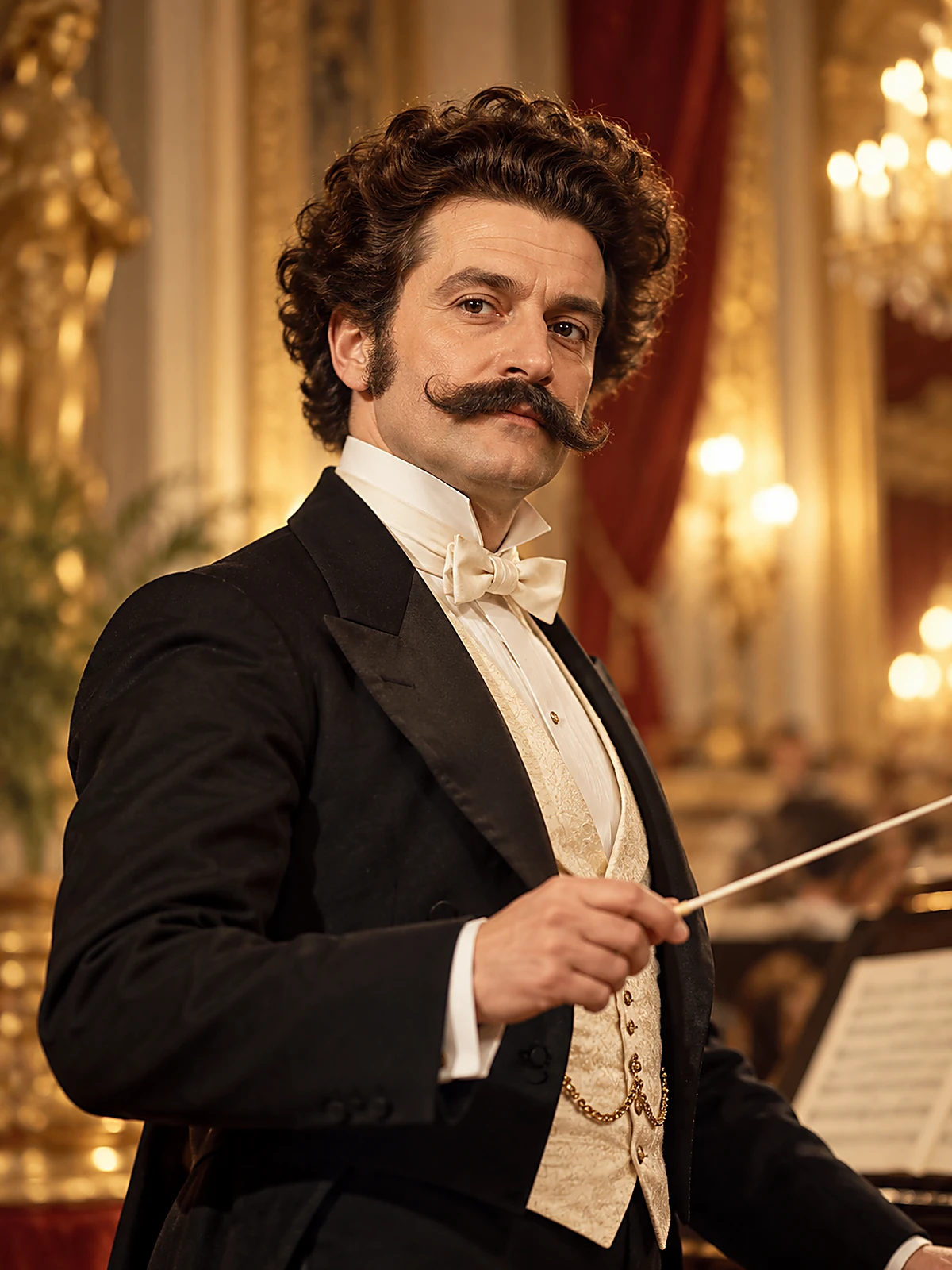
Johann Strauss II transformed Viennese dance music into an international phenomenon. Known as the “Waltz King,” he combined irresistible rhythm with polished orchestration and theatrical flair, leaving works that still define the musical image of nineteenth-century Vienna.
- Born
- October 25, 1825 · Vienna, Austrian Empire
- Died
- June 3, 1899 · Vienna, Austria-Hungary
- Nationality
- Austrian
- Historical role
- Composer · Conductor
A musical family and a forbidden career
Johann Baptist Strauss was born in Vienna on 25 October 1825, the eldest son of the already successful bandleader Johann Strauss I and Anna Strauss. His father did not want him to enter the demanding profession of a musician and preferred a commercial career for him. His mother, however, supported his musical ambitions. Johann studied violin and theory privately while receiving a conventional education. After the death of the popular composer Joseph Lanner in 1843, the younger Strauss decided to pursue music professionally. He made his public debut with his own orchestra at Dommayer’s Casino in 1844. The success immediately turned the young musician into a serious rival to his father in Vienna’s highly competitive dance-music world.
The Waltz King
After his father died in 1849, Strauss combined the two orchestras and increasingly dominated Vienna’s ballroom culture. He toured widely, appearing in major European cities and in Russia, and became famous for his ability to write music that was immediately memorable yet carefully crafted. His waltzes brought symphonic color and large-scale form to dance music. On the Beautiful Blue Danube, first heard in 1867, became his most famous composition and later an unofficial musical emblem of Austria. Other enduring works include Tales from the Vienna Woods, the Emperor Waltz and the Tritsch-Tratsch-Polka. His music helped export an idealized image of elegant, energetic Vienna across Europe and beyond.
From ballroom to operetta
In the 1870s Strauss shifted much of his attention from dance pieces to the stage. With help from experienced theatre collaborators, he wrote a series of operettas. Die Fledermaus, first performed in 1874, became the masterpiece of the Viennese operetta tradition, mixing waltz rhythms, social comedy and brilliant ensemble writing. Der Zigeunerbaron was another major success. Strauss’s theatre works showed that the melodic energy of his dances could support larger dramatic structures. His private life was complicated — he married three times — and his career involved relentless composing, rehearsing, conducting and travel. Yet his ability to adapt his style kept him at the center of musical life for decades.
A sound identified with Vienna
Strauss died in Vienna on 3 June 1899 after contracting pneumonia. He left roughly five hundred works, from short dances to substantial stage pieces. His reputation has survived because the best music is more than decorative nostalgia: it combines rhythmic lift, memorable melody, sophisticated orchestration and an instinctive understanding of performance. The Vienna Philharmonic’s New Year’s Concert and countless orchestras around the world continue to keep Strauss’s waltzes and polkas in regular circulation. The Blue Danube in particular has become attached to ceremonies, travel, film and the international image of Vienna. Strauss helped transform a social dance into an enduring concert tradition.
Sources
Illustrations on this page are AI-generated, not archival images.