
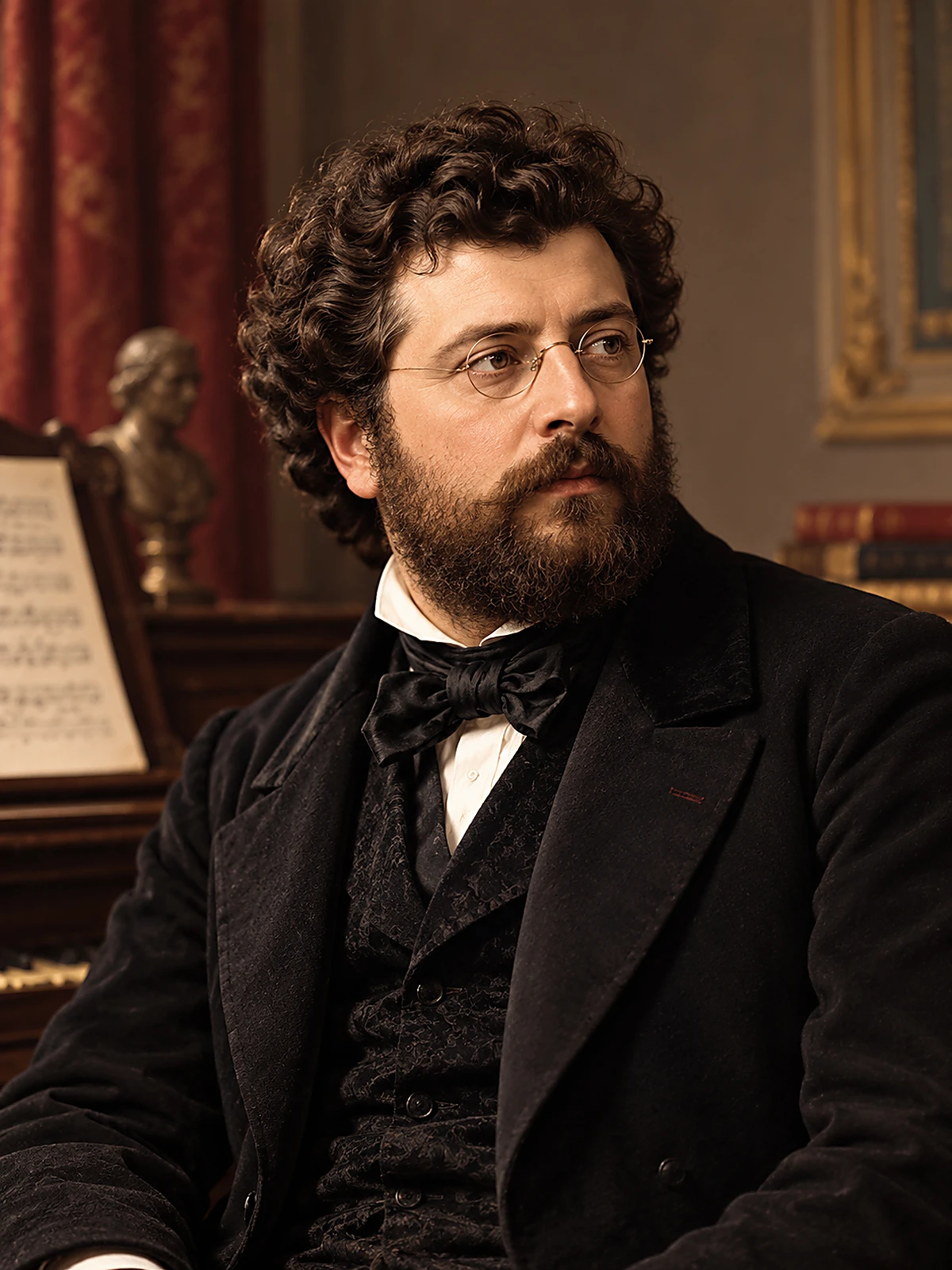
Georges Bizet’s short life produced one of opera’s most durable masterpieces. Carmen was controversial at its 1875 premiere, but its dramatic directness, rhythmic vitality and unforgettable melodies soon made Bizet a central figure in the history of French opera.
- Born
- October 25, 1838 · Paris, France
- Died
- June 3, 1875 · Bougival, France
- Nationality
- French
- Historical role
- Composer · Pianist
A prodigy at the Paris Conservatoire
Alexandre-César-Léopold Bizet, known as Georges, was born in Paris on 25 October 1838 into a musical family. His father taught singing, his mother was a talented pianist, and his abilities appeared early. Bizet entered the Paris Conservatoire before his tenth birthday, where he studied piano, organ and composition and won a series of prizes. He was also an exceptional sight-reader and pianist, though he chose composition rather than a virtuoso career. In 1857 he won the prestigious Prix de Rome, which allowed him to spend several years in Italy. His student years produced music of remarkable fluency, including the youthful Symphony in C, written when he was seventeen and not performed publicly until the twentieth century.
Searching for success on the Paris stage
After returning to Paris, Bizet faced the practical difficulties of making a living as a composer. He worked as an accompanist and arranger while trying to establish himself in the theatre. Les Pêcheurs de perles in 1863 contained music later admired for its color and lyricism, but it did not bring lasting success. La Jolie Fille de Perth and Djamileh also struggled to win a large audience. Bizet’s incidental music for Alphonse Daudet’s L’Arlésienne initially accompanied an unsuccessful play, yet the orchestral suite drawn from it quickly became popular. These years show a composer developing a distinctive language — brilliant orchestral color, sharply characterized rhythms and an increasing ability to make music serve dramatic action.
Carmen and a new dramatic realism
Bizet’s final completed opera, Carmen, opened at the Opéra-Comique on 3 March 1875. Its story of desire, jealousy and violence was unusually direct for a theatre associated with respectable family entertainment, and the first reception was mixed and sometimes hostile. Yet the score contained a concentration of qualities Bizet had been developing for years: sharply defined characters, vivid local color, memorable songs and recurring musical ideas that push the drama forward. The Habanera, Seguidilla, Toreador Song and orchestral interludes became instantly recognizable. Bizet did not live to see the work’s international triumph. He died at Bougival on 3 June 1875, only three months after the premiere, at the age of thirty-six.
A reputation transformed after death
Within a few years Carmen was being performed across Europe, and it eventually became one of the most frequently staged operas in the world. Its success reshaped Bizet’s posthumous reputation, but it can also overshadow the range of his achievement. The youthful Symphony in C, L’Arlésienne, Les Pêcheurs de perles and his piano music reveal a composer of remarkable technical command and melodic imagination. Bizet’s influence lies especially in the way Carmen combines immediately attractive music with unusually concentrated theatrical characterization. Composers and audiences found in it a model for opera that could be colorful, popular and psychologically sharp at the same time. His career was short, but the work he completed changed the repertory permanently.
Sources
Illustrations on this page are AI-generated, not archival images.