
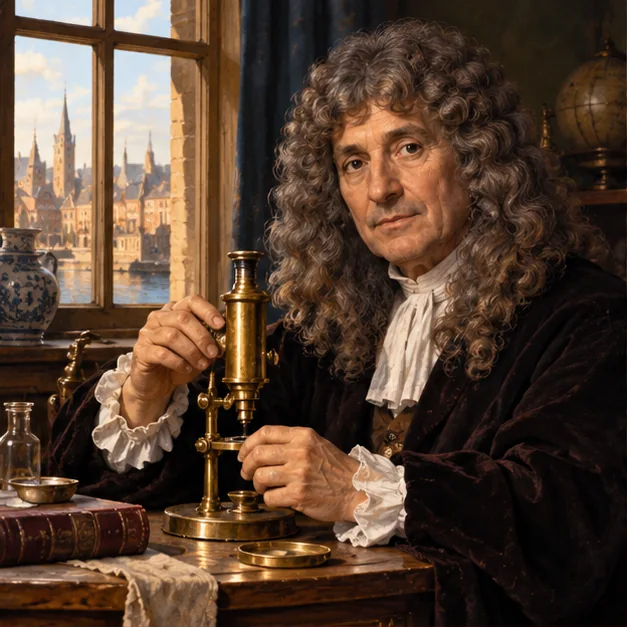
Antonie van Leeuwenhoek (1632–1723) was a Dutch tradesman and pioneering microscopist who revealed a largely invisible world of microorganisms. Using powerful, carefully made single-lens microscopes, he observed tiny living forms and reported his discoveries to the Royal Society in London.
- Born
- October 24, 1632 · Delft, Dutch Republic
- Died
- August 26, 1723 · Delft, Dutch Republic
- Nationality
- Dutch
- Historical role
- Microscopist and merchant
From Delft merchant to investigator
Leeuwenhoek was born in Delft on 24 October 1632. He worked in the textile trade and later held municipal posts. His interest in inspecting fabrics and fine structures encouraged experimentation with magnifying lenses. He was not trained as a university physician and did not invent the microscope. Instead, he developed extraordinary skill in making and using small instruments, treating the material world around him as a source of questions.
A new way of looking
His microscopes used tiny single lenses mounted in metal frames. Objects were placed close to the lens and adjusted with small screws. Although awkward compared with later compound microscopes, the best of his instruments gave remarkable magnification and clarity. He examined water, insects, blood and other specimens. For each subject he tried to observe carefully, repeat what he saw and describe forms and movements that other investigators could not readily detect.
An unseen living world
In the 1670s Leeuwenhoek described minute living organisms in water and other materials. He also investigated red blood cells, sperm cells and microscopic structures. His reports were surprising because they revealed abundance and diversity at a scale largely inaccessible to human sight. Some contemporaries questioned the claims, which made careful descriptions and independent examination important. His correspondence with the Royal Society helped place these observations within the emerging international exchange of scientific evidence.
The legacy of careful observation
Leeuwenhoek continued observing and corresponding for decades and died in Delft in 1723. The later sciences of microbiology and cell biology did not arise from his work alone, but his observations made their development imaginable. His career is a reminder that a person without a conventional academic position can contribute profoundly to scientific knowledge when instruments, persistence and careful reporting come together.
Sources
Illustrations on this page are AI-generated, not archival images.