
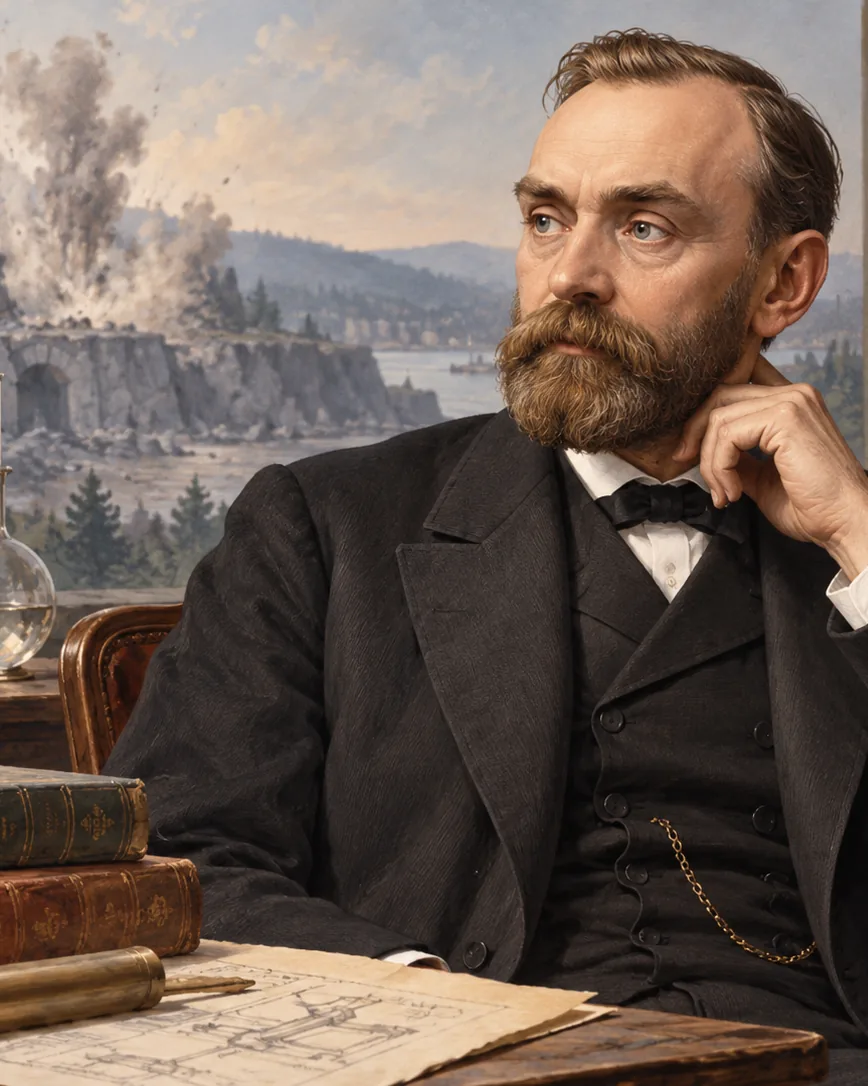
Alfred Nobel (1833–1896) was a Swedish inventor and industrialist whose research into explosives changed engineering and industry. He secured hundreds of patents and built an international business, but his most enduring legacy was his will, which established the Nobel Prizes to recognize achievements in science, literature and peace.
- Born
- October 21, 1833 · Stockholm, Sweden
- Died
- December 10, 1896 · Sanremo, Italy
- Nationality
- Swedish
- Historical role
- Inventor, chemist, industrialist and founder of the Nobel Prizes
Family and education
Nobel was born in Stockholm on 21 October 1833. His father, Immanuel Nobel, worked as an inventor and engineer. After the family moved to St Petersburg in the Russian Empire, Alfred received a broad education that included science, languages and practical engineering.
The young Nobel became interested in chemistry and the practical uses of scientific discoveries. His education and travel brought him into contact with laboratories and industrial enterprises in several countries. He would later combine technical experimentation with the management of factories, patents and investments.
Explosives and invention
Nitroglycerin was powerful but dangerously unstable. Nobel experimented with methods of handling it more safely, and in 1867 patented dynamite: nitroglycerin absorbed in a porous material. This made powerful explosives more practical to transport and use in construction, mining and tunnelling.
Work with explosives remained hazardous, and Nobel’s enterprises faced accidents as well as commercial success. He continued to develop materials and processes, including blasting gelatin and ballistite. Over his lifetime he registered 355 patents, reflecting interests that extended beyond dynamite alone.
International business and intellectual interests
Nobel’s inventions supported an industrial network spanning several countries. He spent important periods of his life in Paris and later in Italy while continuing to manage business interests across Europe. His wealth came from inventions, manufacturing and commercial ventures rather than from a single laboratory discovery.
Alongside chemistry, Nobel read and wrote literature and followed philosophical debates. He corresponded with the peace activist Bertha von Suttner, whose work helped make questions of war and peace personally important to him. His interests help explain the unusually broad range of awards named in his will.
The will that created the Nobel Prizes
In November 1895 Nobel signed his last will in Paris. He directed that much of his fortune support annual prizes for outstanding work in physics, chemistry, physiology or medicine, literature and peace. The will surprised many relatives and required substantial legal and organizational work before its instructions could be fulfilled.
Nobel died in Sanremo on 10 December 1896. His executors worked to establish the institutions and financial arrangements needed for the prizes. The first awards were presented in 1901, five years after his death, turning a private testament into a lasting international institution.
A complicated legacy
Dynamite had legitimate industrial uses but could also be employed in war. That tension remains central to discussions of Nobel’s life. His invention helped reshape the physical infrastructure of the industrial age, while the foundation created by his wealth became associated with scientific discovery, literature and efforts for peace.
The Nobel Prizes outlived their founder and became internationally recognized distinctions. Their existence does not erase the risks connected with Nobel’s industrial work, but it shows how his final decisions gave a new purpose to the fortune he had amassed. His life therefore links technological innovation with questions of responsibility and public benefit.
Sources
Illustrations on this page are AI-generated, not archival images.