
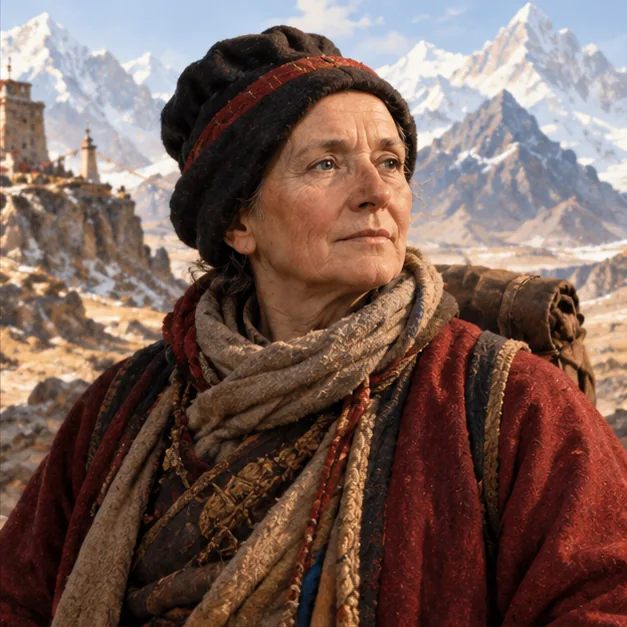
Alexandra David-Néel (1868–1969) was a French traveler, writer and student of Asian religions whose journeys challenged the boundaries imposed on women and on European access to Tibet. Her visit to Lhasa in 1924 and her influential books helped introduce readers to Himalayan cultures and Buddhist thought.
- Born
- October 24, 1868 · Saint-Mandé, France
- Died
- September 8, 1969 · Digne, France
- Nationality
- French
- Historical role
- Explorer and writer
Independent beginnings
Born on 24 October 1868 near Paris, Alexandra David grew up partly in Belgium and cultivated interests in language, music, philosophy and travel. She pursued studies and artistic work at a time when independent careers were difficult for many European women. Her early engagement with feminist and intellectual movements shaped her determination to cross borders. Rather than following a single conventional profession, she moved between singing, writing, spiritual study and journeys that gradually became the center of her life.
Learning in Asia
David-Néel spent extended periods in India and elsewhere in Asia studying religious practices and philosophical traditions. She traveled under difficult physical and political conditions and learned from teachers while recording her own impressions. Her writings reflect both genuine curiosity and the assumptions of a European visitor of her era. Modern readers can value her persistence while also asking how travel accounts represent people whose languages and communities were frequently misunderstood abroad.
The journey to Lhasa
In 1924 David-Néel reached Lhasa, a city that foreign travelers usually could not enter freely. She traveled with her adopted son, the Tibetan monk Yongden, and used disguises and difficult mountain routes to pass through restricted areas. The journey became the episode for which she is most widely remembered. Her subsequent account combined observations, adventure and reflection, giving international readers an unusual story of travel into a politically sensitive Himalayan region.
Books and legacy
David-Néel wrote extensively about travel, Buddhism and the cultures she encountered. Her work encouraged wider interest in Asian religions among European readers, though scholarly understanding of Tibet has continued to evolve well beyond her accounts. She lived to be one hundred and died in Digne in 1969. Her life remains notable not only for the route to Lhasa but for decades of study, writing and resistance to narrow expectations about what a woman could accomplish.
Sources
Illustrations on this page are AI-generated, not archival images.